HiSers.Sign in

For recruitment agencies

The candidates you cannot place today are still working for you.

Put the people you already represent in front of live mandates at companies running searches now. They stay anonymous throughout, and when a client takes one further, the larger share of the fee is yours. You also get the database, the client workspace and the assessment tools to run your own desk with — included, and yours whether or not anyone opens a dossier.

Free to join. Nothing to pay for adding candidates or for any of the tools. You earn when a client takes one further.

01

Your existing candidates reach live mandates

Every recruiter has strong people they placed once, or shortlisted and narrowly missed with, and no current role for. Add them, and they are matched against briefs at companies running searches right now — including companies you do not work with. Nothing is charged for taking part or for adding someone.

02

They stay anonymous until a client commits

Clients read an anonymised dossier: seniority, sector, achievements, assessment. No name, no employer, no contact details. Nobody can lift your list and approach your candidates directly. The relationship stays yours, and every introduction is made by a person, with the candidate’s consent.

03

Profiles keep themselves current

A CV from eighteen months ago is a liability — the candidate has often moved twice since. Profiles are re-checked against LinkedIn on a schedule, so moves, titles and new skills land in the dossier and each one carries a visible "last checked" date. The candidates you add stay accurate without you touching them.

04

Every candidate arrives properly assessed

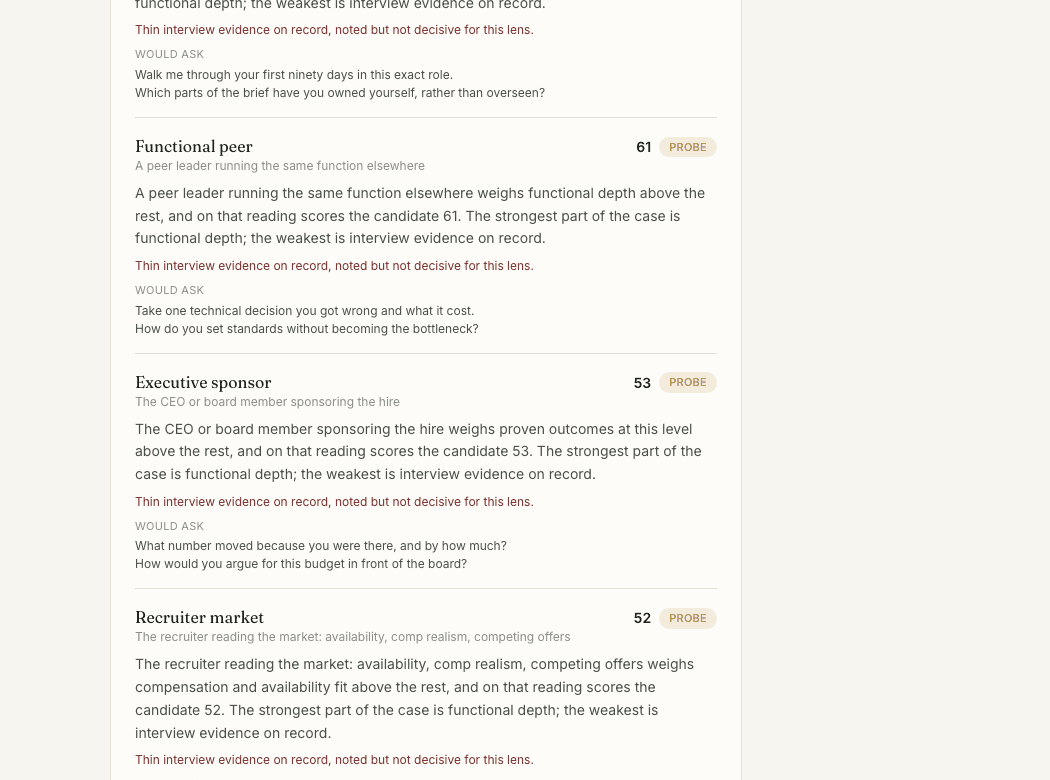
Each profile is read through five lenses — the hiring manager, a functional peer, the CEO or board, the recruiter’s market view and a risk lens — alongside any interview audio, video or notes you hold. Clients see the verdicts, the concerns, the questions to ask and where the lenses disagree. A well-evidenced candidate goes further.

05

Verification keeps the standard up

Every agency is checked before any of its candidates reach a client: a real LinkedIn company page and a working website, reviewed by us. Clients engage because they trust what they are reading, and that trust is what makes your candidates worth putting forward.

Beyond the revenue share

The system you would have bought anyway, included.

Most agencies run on a CRM they resent, a spreadsheet nobody trusts and an assessment tool they pay for by the seat. All of this is switched on the day you are verified, at no charge, whether or not a client ever opens one of your dossiers.

Your database, loaded in an afternoon

Drop in twenty-five CVs at once. Each is read, structured and indexed — including what the CV actually says, not only the fields a parser can lift out of it, so “ran the Basel III remediation” is something you can search for. One unreadable file costs that file and names it; the rest land. Then ask for what you want the way you would ask a colleague, rather than guessing which job title someone happened to use.

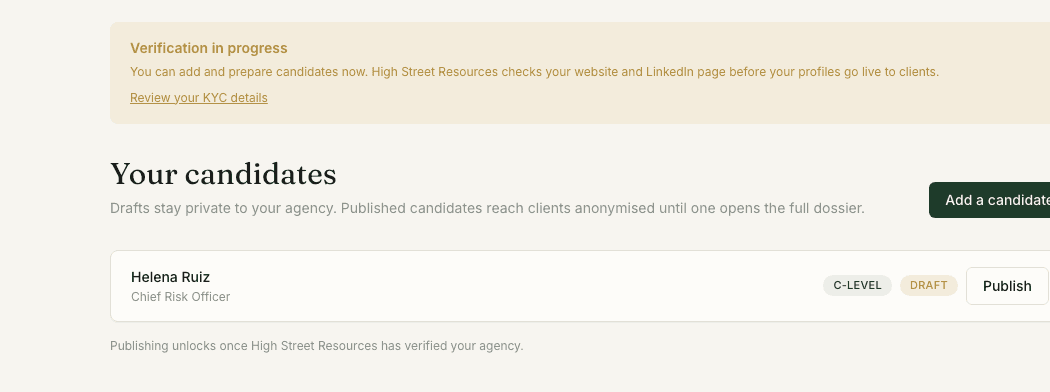
An agency’s own candidate list, each profile publishable once the agency is verified

Your clients, in your workspace

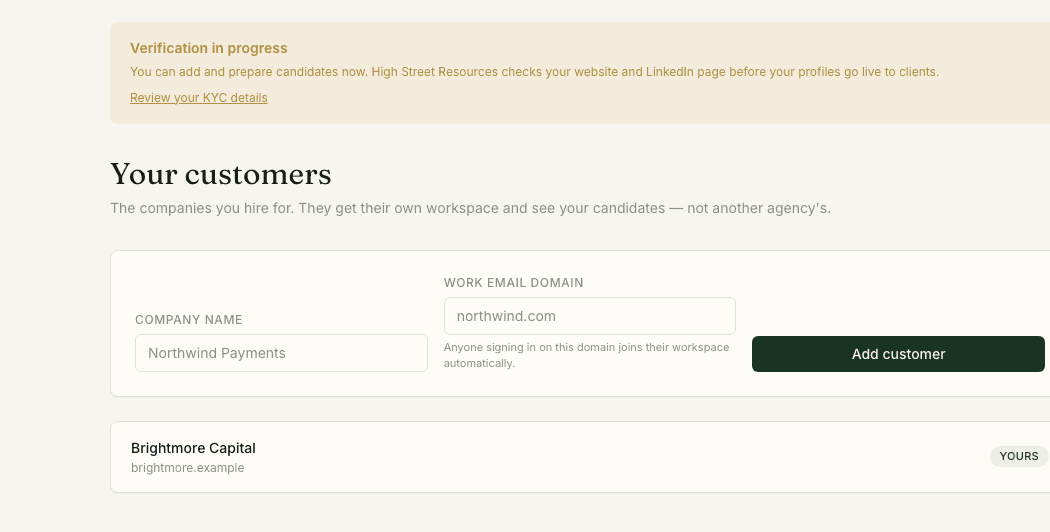
Add the companies you already act for. They sign in, brief their roles, and are matched against your bench and nobody else’s — a rival agency’s candidates never appear in front of your client, and yours never appear in front of theirs by accident. The relationship stays where it was.

An agency adding one of its client companies by name and work email domain

Every unlock, itemised

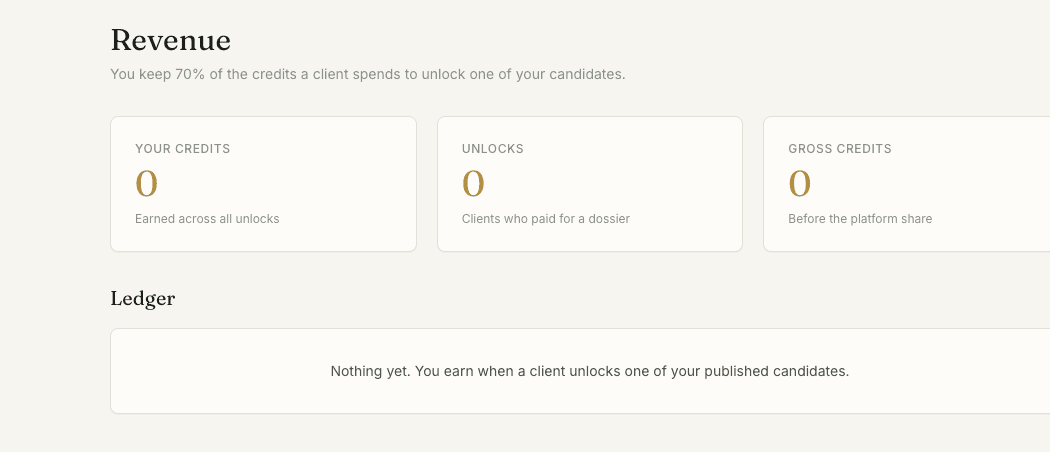
One page showing what each opened dossier earned you and when. It settles per dossier rather than per month, so there is nothing to reconcile at the end of a quarter and nothing to chase.

An agency revenue page showing credits earned per unlock and the ledger behind them

Assessment you would otherwise be paying for

AI interviews in nine languages, leadership assessment across five fixed dimensions, technical screening by discipline. The candidate answers on camera or by typing; you get the recording, the transcript and a report scored section by section with the evidence quoted, and anything they did not address marked unanswered rather than marked down. A candidate you put forward with that attached is a different proposition from one you put forward with a CV.

A list that does not rot

Profiles re-check themselves against LinkedIn on a schedule. Moves, new titles and new skills arrive on their own, and every profile carries the date it was last checked. The hundred people you loaded eighteen months ago are still worth something, which is not usually true of a spreadsheet.

Notes that stay yours

Contact details you can correct, and a running series of notes per candidate — what they said on the phone, what they will not move for, who has already seen them. Internal to your firm: no client reads them, and neither does another agency.

Screens are the real product, with demonstration data.

How the money works

There is no subscription and no charge for adding candidates. Money only moves when a client opens a dossier.

1

A client matches with one of your candidates and spends credits to open the full dossier.

2

The agency representing that candidate takes the larger share of the access fee by default. It settles per dossier opened, not per month.

3

What happens next stays yours. The introduction, the placement, the fee and the terms with the client remain your business, and we take nothing from them.

What you get to use

The apps on top of the bench

Vetted candidates and the assessment engine are the core. Everything below runs on top of that core and is already on — switch off anything you would rather not use.

Available now

On from the day you sign in, and running on the same vetted bench. Screens are the real product with demonstration data.

Five stakeholder lenses scoring one candidate, each with its own verdict and questions
Assessment

Multi-perspective review

One candidate read by five different lenses, not one.

The hiring manager, the functional peer, the CEO or board, the recruiter’s market view, and a risk lens each return their own verdict, score, concerns and questions — plus where they agree and where they split. One-shot analysis cannot show you a disagreement.
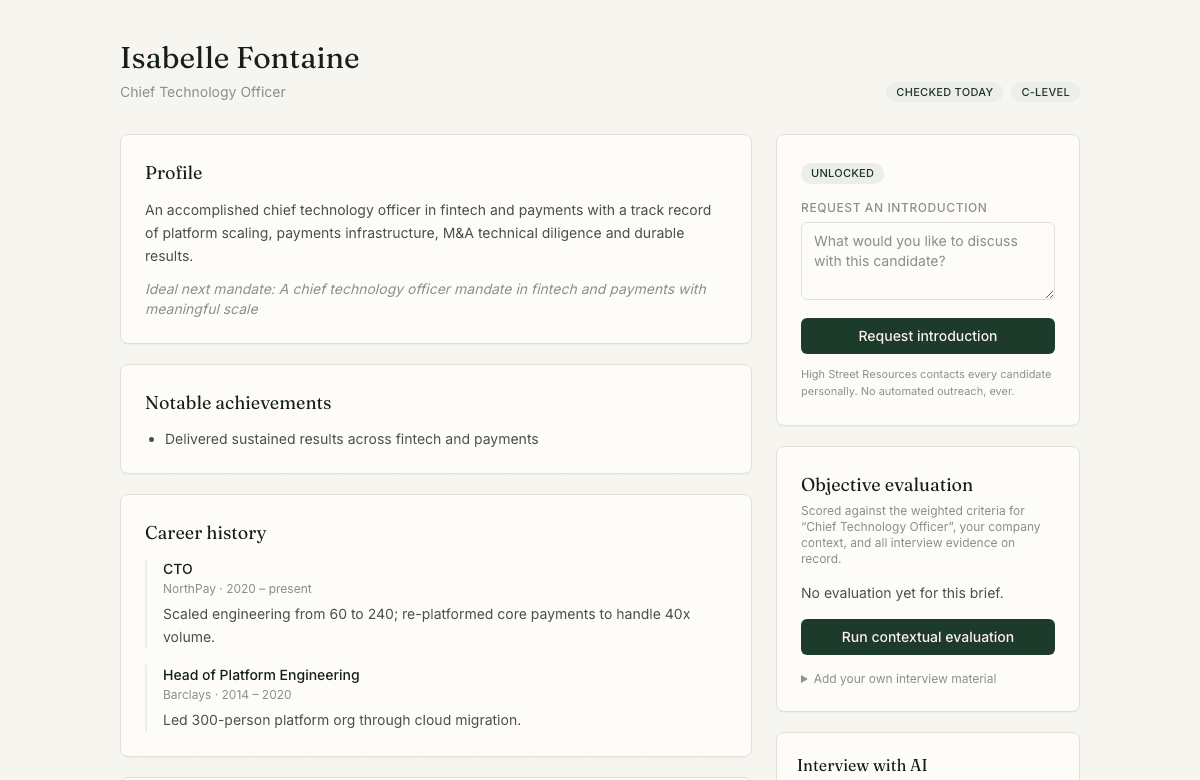
An unlocked dossier showing career history, expertise and when the profile was last checked
Data

Profile freshness

Profiles refresh themselves from LinkedIn, and show what changed.

A paid-for profile that is two jobs out of date is worse than no profile. Candidates are re-checked against LinkedIn on a schedule; every dossier carries a "checked" date, and a change log records the moves, titles and skills that shifted.

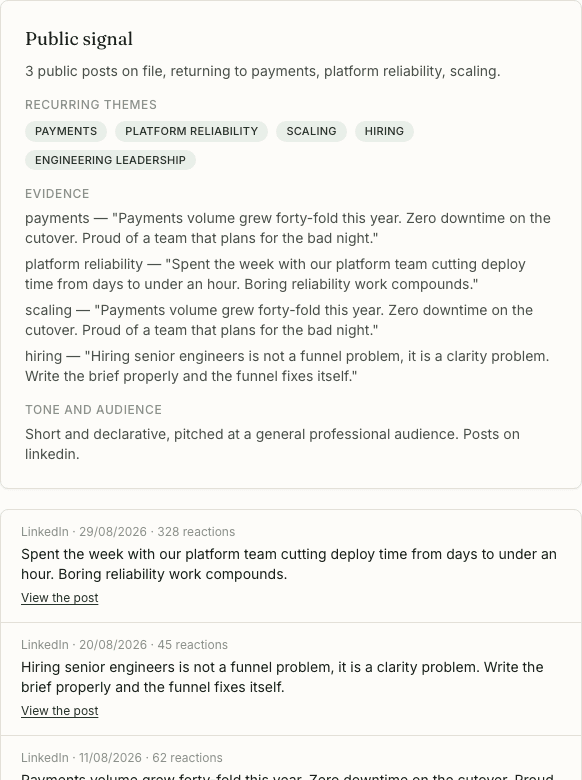
A public signal read: recurring themes drawn from a candidate’s posts, each quoted as evidence
Assessment

Public signal read

What a candidate publishes, read as evidence.

Recent LinkedIn and X activity is collected and read for themes, demonstrated expertise, tone and anything worth a second look — evidence a CV cannot give you, feeding the same evaluation engine.

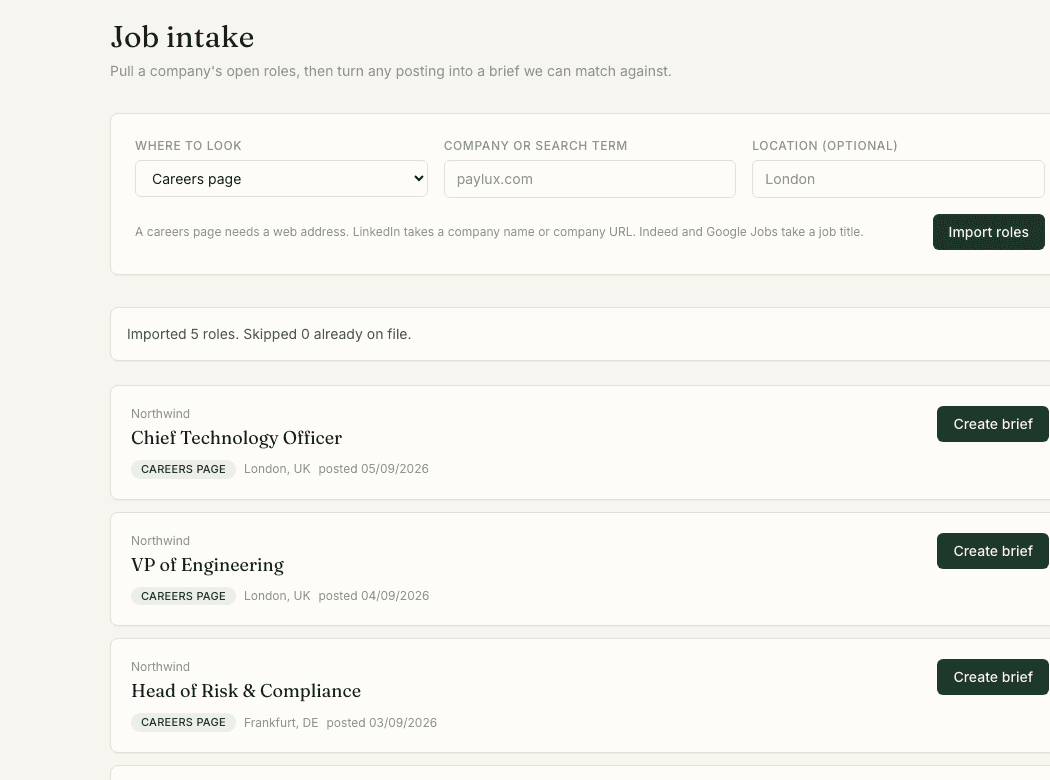
Open roles pulled from a careers page, each convertible into a brief in one click
Sourcing

Job intake

Pull a company’s open roles and turn one into a brief.

Give a careers page, a LinkedIn company, or a search on Indeed or Google Jobs, and the openings come back in one list. Convert any posting into a working role brief with a click.

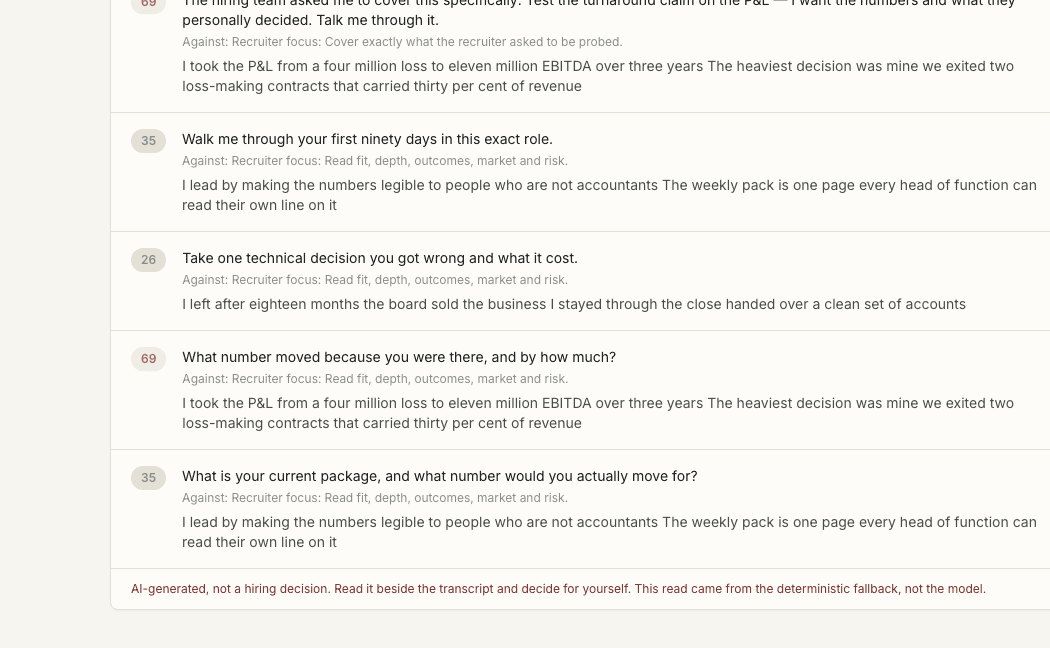
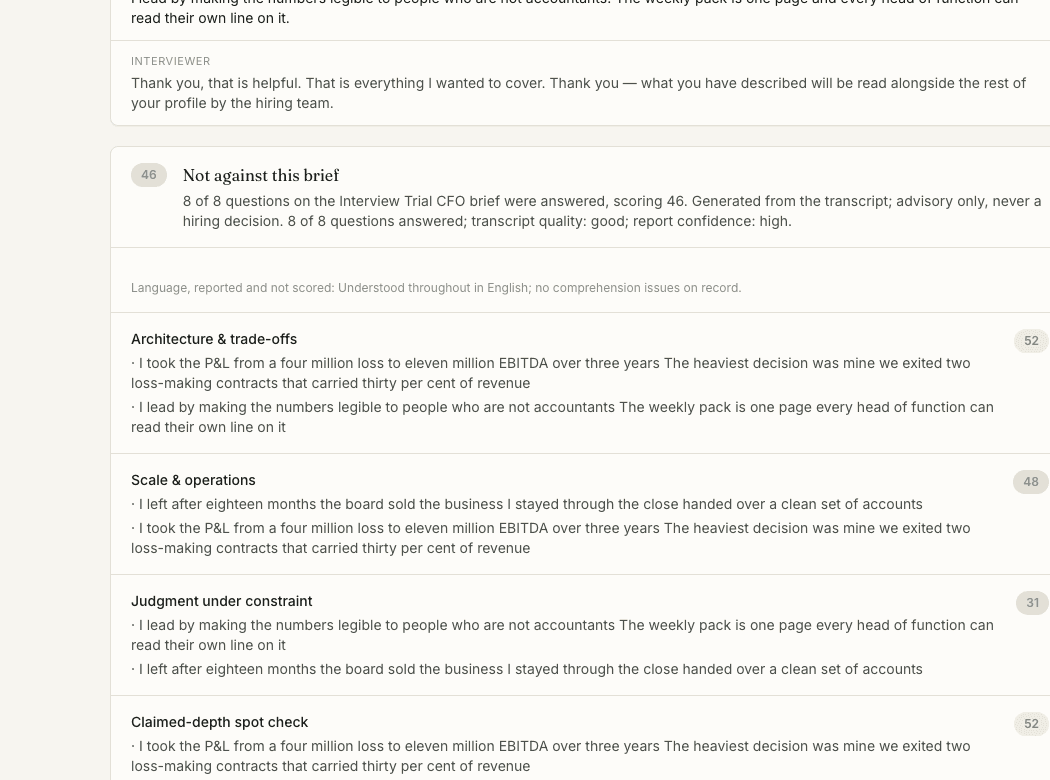
An interview report scored question by question, each citing what the candidate said
Assessment

Automated video interview

A real conversation with an AI interviewer, in nine languages.

Write a line about what you actually want probed and the script is triaged from your prompt, the brief, your company profile and the dossier — so nobody is asked what their CV already answers. The candidate joins a live conversation in one of nine languages; the interviewer follows up on what they hear rather than reading a form. You get the transcript, a per-question read that cites the brief criterion it answers, and a score that feeds the same evaluation engine. It is advisory: AI-generated, not a hiring decision.

A technical screening report scored by section with the evidence quoted
Assessment

Technical screening

Qualify technical candidates a generalist recruiter cannot.

Four fixed sections — architecture, operating history, judgment under constraint, a depth spot-check — asked against the role brief in the interview room, on camera or typed, and scored with cited evidence. No puzzles; decisions owned and systems operated.

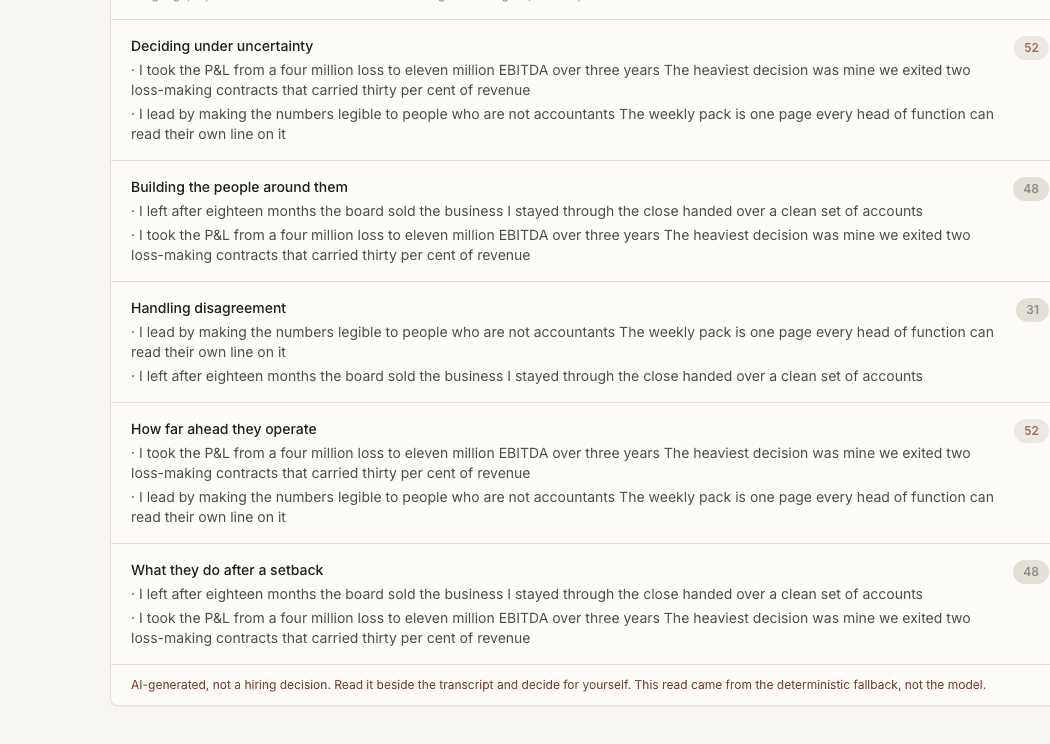
A leadership assessment read across five fixed dimensions with the evidence for each
Assessment

Leadership assessment

Five fixed dimensions, asked against your mandate, answered by video or text.

A structured read on how someone leads: deciding under uncertainty, building the people around them, handling disagreement, how far ahead they operate, and what they do after a setback. The dimensions are fixed so two candidates are comparable; the questions are written against your company and this mandate, so nobody is asked something generic. The candidate answers in the same room as a video interview — on camera, or by typing if they would rather — and the report scores each dimension with the evidence it used, marking anything they did not address as unanswered rather than weak. Advisory: AI-generated input for a human decision, not a decision.

Names identified in the market for a brief, each with the evidence behind them
Sourcing

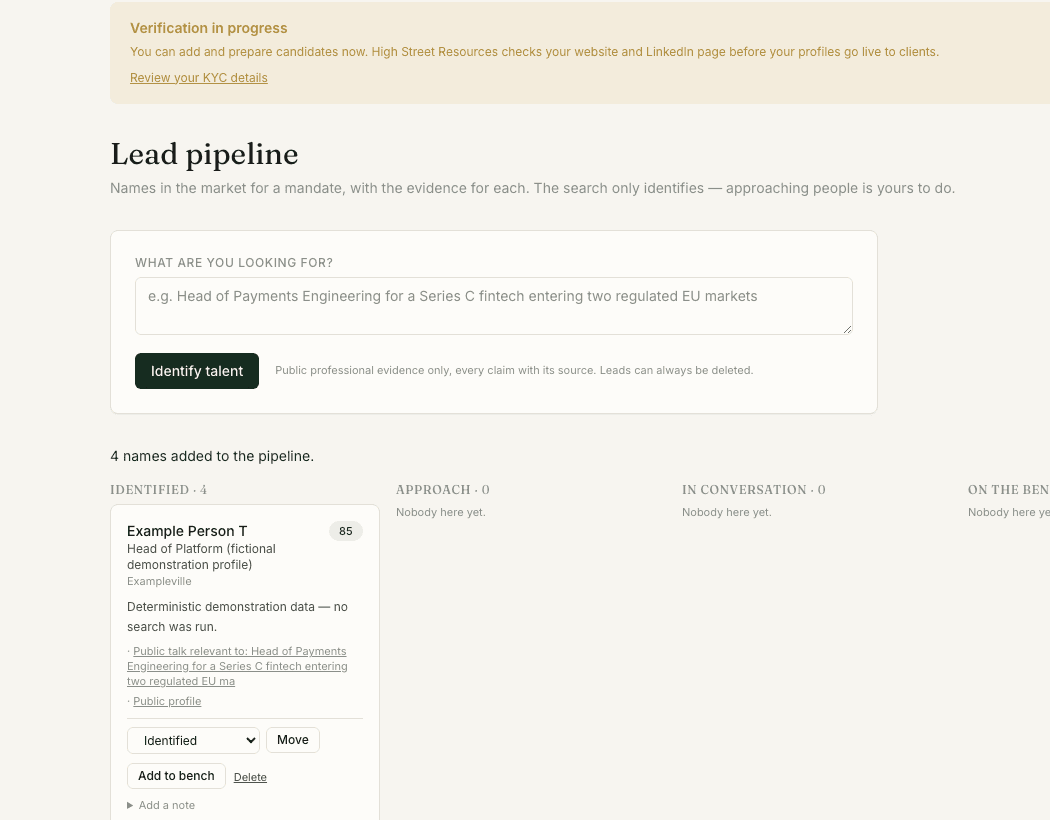
Talent identification

Names in the market for a mandate — you decide who to approach.

Identification only, never automated outreach: describe a mandate and the app searches the public web for who is doing this work in your market, with the evidence for each name, triaged into a lead pipeline you work stage by stage. The approach stays human.

Start with ten candidates and see what happens.

Verification takes a LinkedIn company page and a working website. After that, add your candidates and earn whenever a client takes one further.

Join as an agency